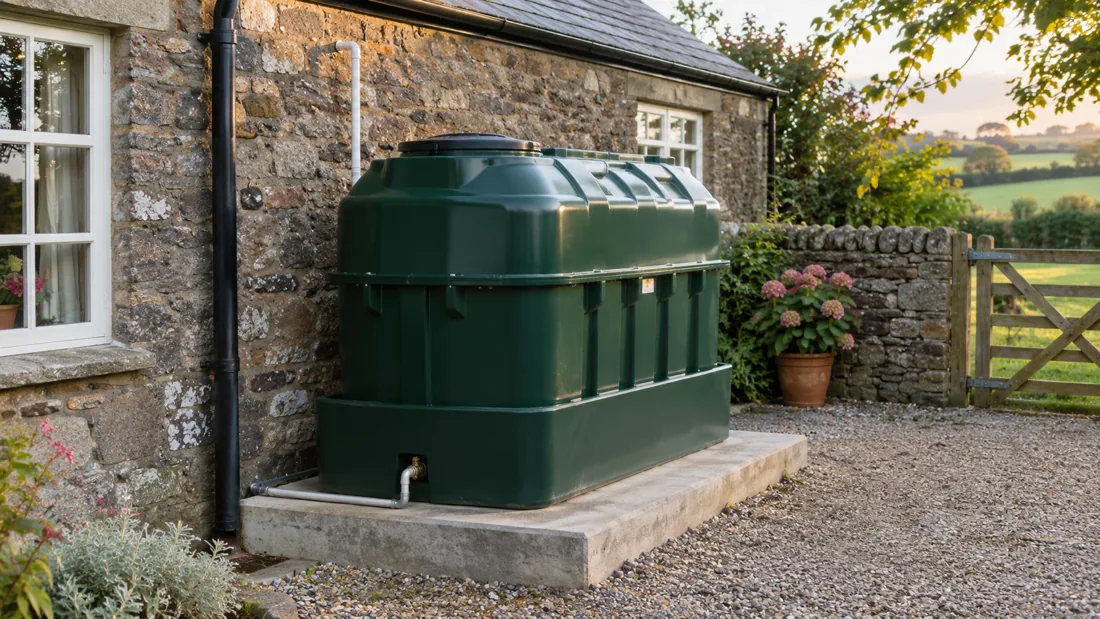
Start With The Reason For Replacement
A replacement tank should solve the problem that prompted the enquiry. Cracked or distorted plastic, rusting steel, damaged fittings and movement beneath the base all deserve assessment. A delivery refusal, repeated water problems or plans to change the garden can also make replacement worth considering.
Age alone does not select the new tank. Its condition, location and the support beneath it matter, along with your actual fuel use. Send photographs and explain any recent changes rather than relying on a description such as “the same size again”.
Keep The Position Or Move It?
Keeping the existing location can reduce disruption, but only if it remains suitable for the new installation. The base may have settled, a new window may be nearby or vegetation may hide an overflow route. The replacement's footprint can differ even where its stated capacity matches the old tank.
On Devon's sloping plots, a level support platform and the stability of surrounding ground need attention. A new position should also allow inspection, future maintenance and fuel delivery. A convenient corner is not automatically a suitable tank location.
The assessment should consider buildings, boundaries, drains and nearby water, together with manufacturer requirements. New and replacement domestic tanks in England must meet Building Regulations. The contractor should explain the compliance route for your job before installation, as described in the linked government guidance.
Choose Capacity And Containment Together
Tell us roughly how often you order oil, whether the property is occupied throughout the year and whether heating demand has changed. A larger tank is not always the best answer if access, support or delivery arrangements become difficult. Shape and capacity should be considered together.
An integrally bunded tank has secondary containment around the inner storage vessel. The need for containment follows the applicable rules and pollution risk assessment. Describe wells, springs, boreholes, ditches and drainage even if they are beyond your boundary, and do not assume that a double-skinned product provides a compliant bund.
Plan The Changeover
Before the work, agree what happens to the remaining oil and how long the heating will be unavailable. Usable oil may be held temporarily and transferred, subject to its condition. Sludge and water need separate handling and should not simply be pumped into the new tank.
The normal sequence is controlled isolation, recovery of contents, removal of the old tank, preparation of the support and placement of the replacement. Connections and safety components are then checked, followed by appropriate commissioning. A base that needs construction or curing can extend the programme beyond the tank change itself.
Access And Continuity
Measure the narrowest gate if it is safe to do so and describe steps, tight turns and changes in level. Include photos of the vehicle standing area and the complete path to the tank. Wet ground and a narrow lane can affect equipment choices even where the garden itself is spacious.
For an occupied home, explain if loss of heating or hot water creates a particular difficulty. Temporary storage or supply may be an option, but it requires its own suitable position, connections and cost allowance. Business users should identify critical plant, shutdown restrictions and the person who can authorise the changeover.
Compare The Full Scope
A useful quote separates the tank, old-tank removal, oil handling, base preparation and connection work. New pipework, filters, valves, impact protection and changes to the fill arrangement can alter the total. Ask which items are included and what remains subject to an inspection.
Do not compare quotations on tank capacity alone. Material, dimensions, containment, access arrangements and the extent of making good may differ. If commercial storage is involved, give the fuel type and use so the relevant storage and fire risk requirements are assessed for the actual operation.
Handover And Future Checks
Request the product details, warranty terms, installation and commissioning records, and the relevant Building Regulations evidence. Ask the installer to explain how notification is being handled. Records for the removed tank and waste should match what was actually taken away.
After handover, keep the tank accessible for inspection and delivery. Know where the fill point is and keep the vent unobstructed. Follow the manufacturer's maintenance advice and arrange competent inspection rather than treating a new tank as maintenance free.
Information To Send
Include your postcode, existing tank capacity, approximate oil level and the reason for replacement. Photograph the tank label, all visible sides, the base and nearby structures. Add views of the access route and any alternative position you would like assessed.
Say whether the property is a home, holiday accommodation, farm or business premises. Mention planned extensions and landscaping, as well as any known drainage or water source. This helps distinguish a straightforward exchange from a replacement that also needs a new site layout.
Your Questions
Can I Keep The Oil In My Old Tank?
Remaining oil may be suitable for transfer during replacement, but its condition needs checking first. Water, sludge or the wrong fuel can make reuse inappropriate. Tell us the approximate quantity when enquiring, and ask the quote to describe temporary holding, transfer and disposal so the fuel handling is agreed before work starts.
Will A Replacement Stop My Heating?
Tank replacement involves a period when the fuel supply is disconnected. Agree the expected interruption with the contractor, particularly if new base work is involved. If heating continuity is important, ask whether a temporary arrangement can be assessed and quoted, including its position, setup and later removal.
Further guidance: GOV.UK: home oil storage, business oil storage and HSE: confined spaces.
Tell Us About Your Tank
Start with your postcode, what has changed and how the tank can be reached. A suitable service provider can then respond about the next assessment.
Make A Tank Enquiry